
The Bamoun people
In the heart of the western highlands of Cameroon, the Bamoun Kingdom took shape over the centuries.
Founded in the 14th century, it became one of the most powerful and organized kingdoms in Central Africa.
Foumban, its capital, was a center of art, politics, and spirituality.
Here, symbols were never chosen at random.
Every carved motif, every insignia, every woven fabric had meaning.
The Bamoun people knew how to translate their history and their struggles into visible, memorable signs.
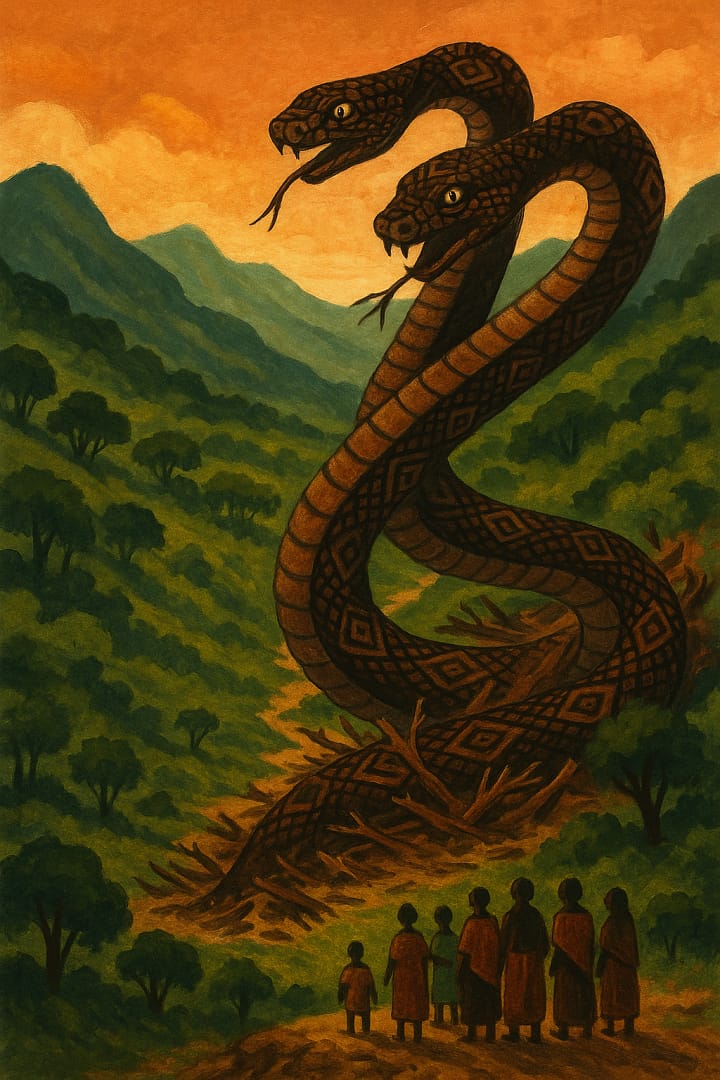
Among these symbols, the two-headed serpent is perhaps one of the most striking.
But to understand its origin, we need to go back to a key moment in the kingdom’s history:
the reign of King Njoya.
King Njoya: a sovereign facing adversity
In 1892, Njoya ascended the throne at just 25 years old.
Yet he inherited a fragile kingdom, torn by internal tensions and surrounded by external threats.
Internally: Succession disputes and rebellions.
Externally: Conflicts with neighboring kingdoms (Tikars, Bamiléké…) and, more worryingly, growing pressure from European colonial powers—especially Germany.
Njoya quickly understood that to protect his people and his kingdom, he needed to show both strategy and authority.
He strengthened his army.
He launched military campaigns to secure the borders.
And above all:
He needed to inspire both fear and respect.
The birth of the two-headed serpent
It was in this context of struggles and victories that the symbol of the two-headed serpent was born.
According to oral traditions and royal archives, it was after several successful military campaigns that Njoya chose this symbol to represent his vigilance and power.
Why a serpent?
Because in African symbolism, the serpent is a creature of power, knowledge, and protection.
But Njoya went further.
He chose a serpent with two heads.
One head turned toward the future: to spot enemies and anticipate threats.
One head turned toward the past: to remember betrayals and mistakes, to remain master of his own history.
Two perspectives, but one body: a symbol of unity.
A clear message to his people and his enemies:
“I see you. Wherever you come from.”
From the battlefield… to the royal coat of arms
The two-headed serpent quickly moved beyond its initial military context.
It became an official emblem of the Bamoun kingdom:
Carved onto thrones,
Engraved on ceremonial weapons,
Embroidered onto royal garments,
And later, integrated into the official coat of arms of the kingdom.
This symbol became the visual embodiment of the strength and vigilance of the Bamoun sovereign.
But Njoya’s reign went far beyond military victories.
He created an alphabet, the Shümom, so his people could write and preserve their history.
He had royal chronicles written.
He built the royal palace of Foumban, which still stands today.
And he negotiated skillfully with the Germans, maintaining a form of autonomy even during colonization.
The two-headed serpent thus became part of a reign that was military, political, cultural, and spiritual all at once.
Why this symbol in my book?
In my story “The Oath of the Two-Headed Serpent,” I wanted to evoke this idea of unity through difference, of courage, collective memory, and the destruction of ego for the greater good.
Even though the serpent in my tale exists in a fictional context, it remains inspired by this historical symbol.
A lesson still relevant today
Even today, the two-headed serpent continues to resonate with those who know its story.
It reminds us:
That vigilance is necessary,
That protecting those we love often requires setting aside personal ego,
And that the memory of past struggles is a source of collective strength.
And you?
In your culture, do you know of symbols that tell stories of resistance, protection, or victory?
I would love to hear about them.
Feel free to share in the comments.
Sources and References for Further Reading:
Ouvrages et articles sur le royaume Bamoun et le roi Njoya :
Jean-Paul Notué & Bianca Triaca, Royaume Bamoun : art et histoire au Cameroun, Éditions Musée d’Art Africain de Genève / Edition Afrique contemporaine, 1993.
Claude Tardits, Le royaume bamoun, Cahiers de l’homme, 1980 (réédition Karthala).
König, Klaus, Foumban : art et traditions du Cameroun, Musée Rietberg Zürich, 1986.
Austen, Ralph A. & Derrick, Jonathan, Middlemen of the Cameroons Rivers: The Duala and Their Hinterland, c.1600–c.1960, Cambridge University Press, 1999.
Articles et ressources en ligne :
UNESCO – Le roi Njoya et l’invention de l’écriture Bamoun (Shümom) : https://ich.unesco.org
Musée du Quai Branly – Dossiers sur les arts du Cameroun : https://www.quaibranly.fr
Musée du Palais Royal de Foumban.
Important Note:
The information presented in this article is based on the historical, ethnographic, and oral knowledge available at the time of writing.
Research on African cultures continues to evolve.
Many areas of knowledge were long under-documented or, at times, misinterpreted by colonial sources.
Some interpretations may change or be expanded in the future as new discoveries and testimonies emerge.
My intention here is above all to share, with respect, a story and a symbol that inspired me—without claiming to provide an exhaustive account.
Merci c’etait merveilleux
my comment