
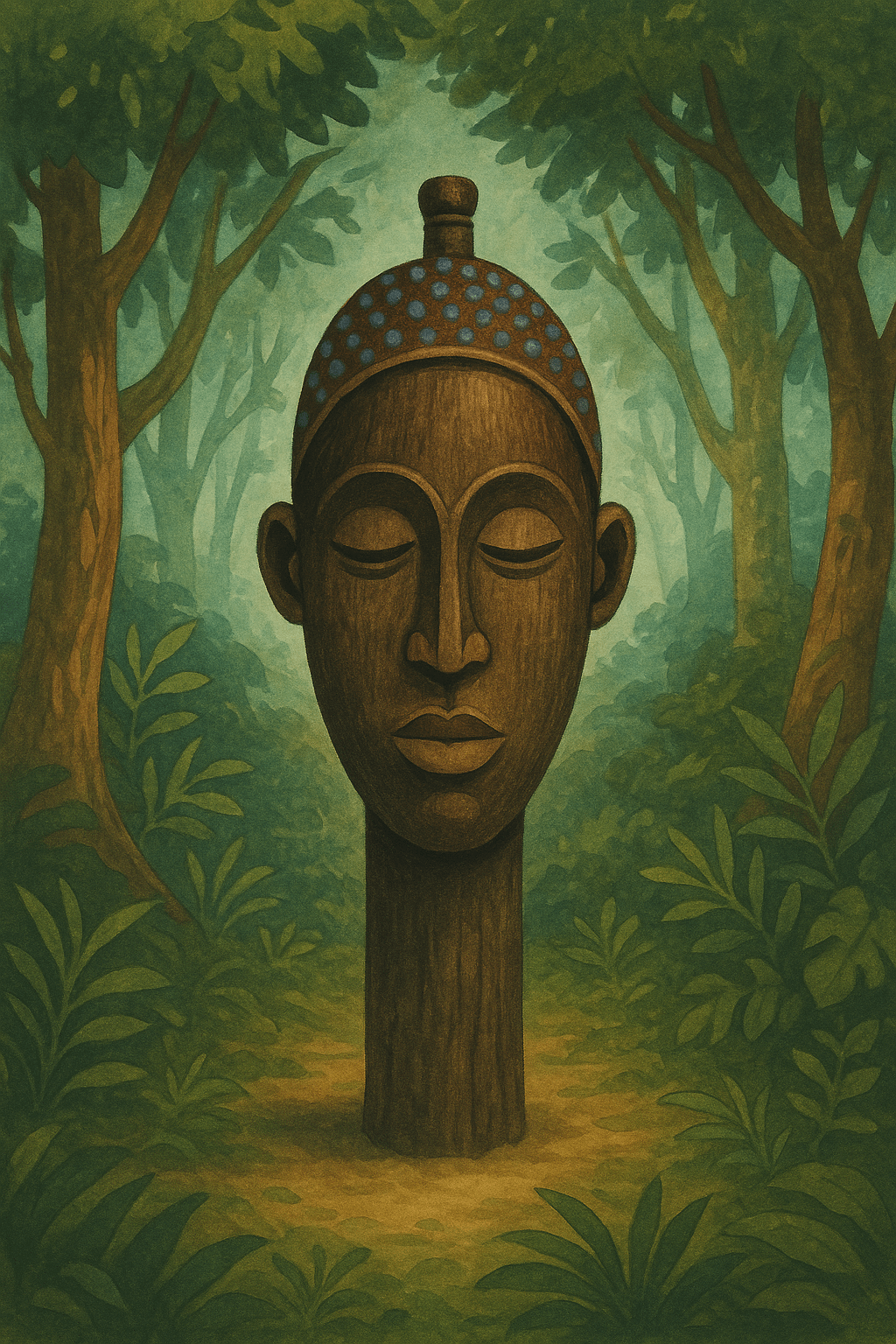
When you grow up in a Cameroonian city, traditional masks are something you don’t often come across.
Maybe, hanging on a wall at an uncle’s house. In a craft shop. Behind the glass in a museum.
Personally, as a child, I found them terrifying. I did everything I could to avoid looking at them for too long.
Some people find them pretty. Others find them impressive… But very rarely do we imagine the story they carry.
It was when I discovered Fang culture that I finally understood: these masks are not just decorative objects.
They are alive.
They watch.
They keep vigil.
The Byeri: more than just a work of art
In Fang tradition, found in Cameroon, Gabon, and Equatorial Guinea, the Byeri is at the heart of the relationship between the living and the ancestors.
What does the word “Byeri” mean?
It refers to:
• An ancestor cult, centered on the veneration of family lineages.
• A system for preserving family relics, often the skulls of ancestors.
• And the famous carved wooden figures that watched over these relics.
These sculptures, slender and stylized, were kept in special boxes or placed on family altars, hidden from the eyes of non-initiates.
They were not there for decoration: they protected, they taught, and they reminded people that the life of the living remains closely tied to that of the dead.
The initiatory role of the Byeri
In Fang society, the Byeri also had an essential educational role.
It was present during the initiation rites for young boys, marking their transition into adulthood.
Through the Byeri, they were taught:
• Respect for elders,
• Knowledge of their lineage,
• And the responsibilities tied to age and maturity.
Looking at a Byeri without preparation was strongly discouraged.
It was believed that this could cause spiritual imbalance, illness, or even attract bad luck.
The Byeri in my story
In my story “The Mask of Bayendo”, I chose to tell that particular moment when a child’s curiosity pushes them to break a taboo.
Asuma, the young hero, represents that thirst for knowledge that sometimes leads us to cross boundaries.
But here, it’s not about a simple moral punishment or a gratuitous fear lesson.
His journey is a path of learning, guided by the signs sent to him by the forest.
In the story, the forest itself becomes a character—a silent, serious, but benevolent guide.
Why this story in my collection “Tales for the Evening”
With “The Mask of Bayendo,” I wanted to talk about the boundary between ignorance and knowledge, carelessness and respect, childhood and responsibility.
This story is especially dear to me. Because, in some way… I saw myself in Asuma. Like him, I didn’t always want to settle for the ready-made answers we were given as children where I come from. Those famous lines like:
“Go over there, you ask too many questions,”
or
“Curiosity will get you killed.”
The goal was not to reproduce a real or sacred initiation ritual,
but rather to awaken in the reader an awareness that some knowledge must be earned.
And that sometimes, it’s necessary to step outside dogma.
For Asuma, that choice came with a cost.
Was it worth it?
I’m eager to discover the answer from those who will read the story.
For me, this story is an invitation to question, a small attempt at stepping out of the cave, as Plato would have said.
Where are the Byeri today?
Today, many Byeri figures are kept in museums around the world: Paris, New York, London, Geneva…
Often, these pieces were collected—or taken—during the colonial period, without always respecting the sacred context that surrounded them.
But in some Fang families, these figures still exist, carefully preserved, even if their ritual use has become rare today.
In conclusion
Behind a simple mask…
an entire lineage may still be keeping watch.
And you?
What objects in your family or your culture carry memory?
I would love to hear about them. Feel free to share in the comments.
Sources and References for Further Reading:
• Louis Perrois, Arts du Gabon : Fang, Kota, Punu…, Éditions Adam Biro, 1997.
An essential reference work for understanding Fang art and the role of the Byeri in ritual practices.
• Louis Perrois, Byeri Fang : Sculpture d’Afrique équatoriale, Éditions Somogy, 1992.
A book entirely dedicated to the Byeri and its various artistic forms across Fang regions.
• Philip Ravenhill, Dreams and Reverie : Images of Otherworld Marriage in East African Art, National Museum of African Art, Smithsonian Institution, 1993.
(Contains an interesting chapter on ancestor cults in Central Africa, including the Byeri.)
• Susan Vogel (dir.), African Masterpieces from the Musée de l’Homme, The Center for African Art, 1985.
An exhibition catalog featuring several Fang objects, including Byeri figures, with strong historical context.
Other resources
• Musée du Quai Branly – Dossier pédagogique sur les arts Fang et le culte des ancêtres
https://www.quaibranly.fr
• Metropolitan Museum of Art (New York) – Byeri Reliquary Figures (Fang Peoples)
https://www.metmuseum.org/art/collection/search/310870
• Smithsonian National Museum of African Art – Collections Fang
https://www.si.edu/object/reliquary-guardian-figure:nmafa_72-41-3
• UNESCO – Les arts traditionnels Fang et la mémoire des ancêtres
https://ich.unesco.org
Important Note:
The information presented in this article is based on historical, ethnographic, and oral knowledge available at the time of writing.
Research on African cultures continues to evolve. Many forms of knowledge were long under-documented or sometimes misinterpreted by colonial sources. Some interpretations may therefore change or be expanded in the future as new discoveries and testimonies emerge.
My intention here is above all to share, with respect, a story and a symbol that inspired me—without claiming to offer a fully exhaustive account.

I’m very impressed.
Congratulations
Thank youu 😊😊😊