Let’s go a little deeper today.
Let’s talk about the origin of life and water symbolism in African traditions.
Let’s talk about The Source From Below, the first tale in my book Tales for the Evening.
“But it doesn’t sound like a tale…”
Before the book even came out, some of my friends who read early drafts told me:
“You should put that story last, not first. It’s too abstract. It feels more like a poem than a tale.”
They weren’t wrong.
But I was a bit stubborn on this one, so I kept it exactly where it is, as the first tale, just after the dedication.
Why?
Because to me, it felt sacred.
Like the opening lines of Genesis in the Bible: “In the beginning was the Word, and the Word was with God, and the Word was God.”
In Tales for the Evening, “The Source From Below” plays that role. It’s where everything begins.
it tells the origins.
Posi: The Tadpoles of the Soul
In traditional belief, the Bamiléké people of Central Africa, especially in regions like Bangangté and Bafoussam, believed that children come from water.
They called them Posi.
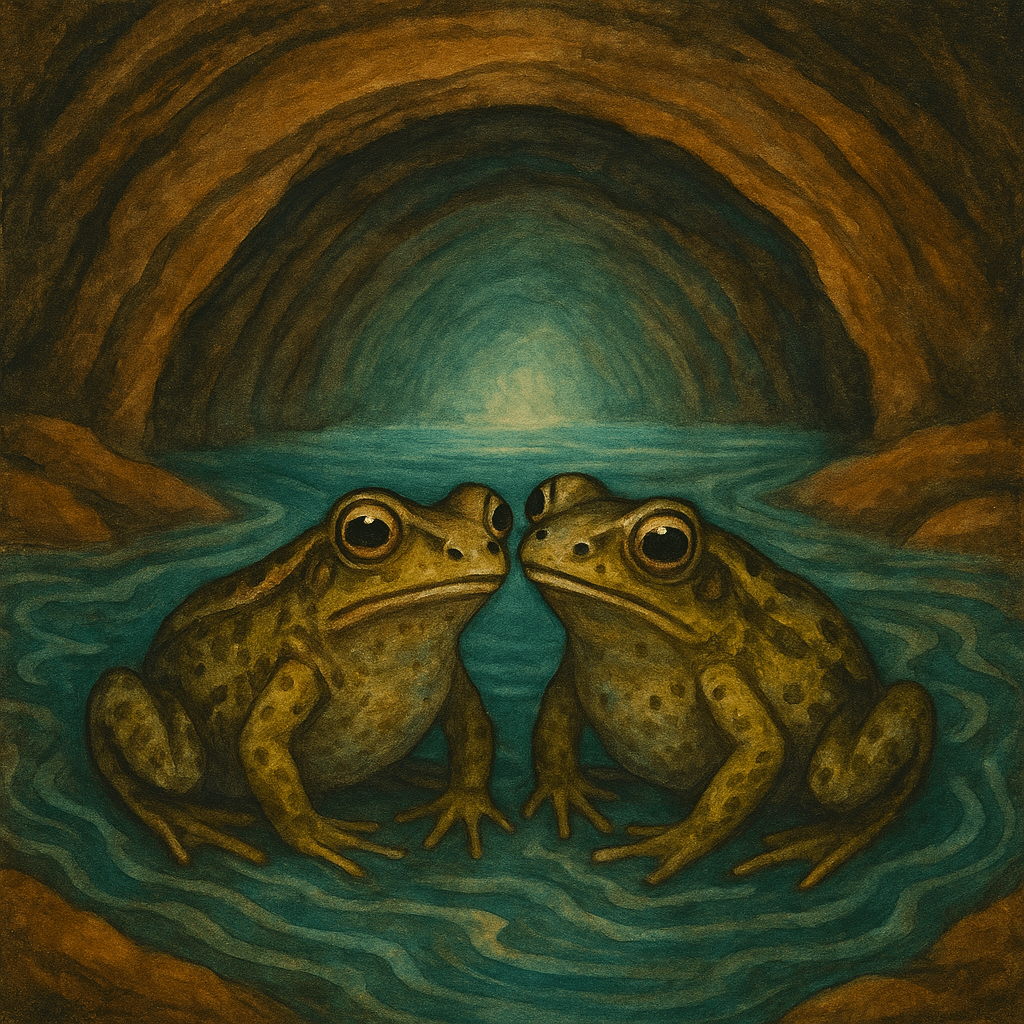
Tiny, tadpole-shaped spirits, floating below the earth, waiting to be born.
In this worldview, children exist before birth, as small amphibious beings living in the water beneath the ground, called the source from below.
When the moment is right, these spirits rise.
They come up, silently.
They cross into the human world.
And when a woman becomes pregnant, it is said:
“The Posi have risen.”
Sometimes, they come alone.
But when a couple is in deep love, the Posi arrive in pairs, like twin toads.
I mean… isn’t that beautiful?
If you’re reading this with someone you love, may you receive a visit from two little toads. Or four, LOL.
Science Meets Myth
This tale hits home for me, because I’m also a biologist by training.
From the water came fish.
Then amphibians.
Then mammals.
Then us, Homo sapiens sapiens.
It’s amazing to realise that the Bamiléké people also believed life started in water centuries ago:
it takes shape as a tadpole, and enters the human world through a sacred passage, a kind of spiritual metamorphosis from water to earth.
They didn’t need a lab to say it.
Or PhDs.
They felt it, and saw it in the cycles of nature.
Why Water Means Life Around the World
The Bamiléké are not the only one to think life started in water.
In Vedic and Hindu cosmology, creation begins in primordial waters, stirred by vibration and sound.
In Taoist philosophy, water is the perfect force: soft and flexible, yet impossible to resist. It flows where it must, carves mountains, and nourishes everything.
As Bruce Lee said:
“Be like water, my friend.”
In Shinto rituals, water purifies, restores balance, and washes away what is stagnant.
And in Ancient Greek thought, water was seen as the underlying substance from which life and movement arise.
Later still, Nikola Tesla spoke of vibration, resonance, and hidden energy flowing through the world, ideas that sound abstract until you watch ripples on a pond. Then suddenly, it all makes sense.
So maybe it’s no surprise that in so many traditions, water isn’t just part of life.
It is life.
Why This Tale Had to Come First
So yes, “The Source From Below” is different from the other stories.
It doesn’t follow a hero.
It doesn’t resolve a conflict.
And it’s not trying to.
I can’t claim to fully grasp the origins of this myth, as it is rooted in the mysticism and spiritual beliefs of the Bamiléké people before colonisation and Christianity — and I was not there back then.
But the story is there to say:
Before all the tales, there was the water.
Before all the names, there was the silence.
Before we tell stories, we listen to what comes from below.
For me, this is the story that holds the others.
Further Reading & References
Oxford University Press. The Origin and Early Evolution of Life.
https://academic.oup.com/book/53124Malaquais, Dominique. Architecture, pouvoir et dissidence au Cameroun.
Paris: Karthala, 2002.
https://shs.cairn.info/architecture-pouvoir-et-dissidence-au-cameroun–9782845862319-page-93?lang=frSauvons le Ndop. “Le crapaud Tetuo et le serpent dans la création de l’enfant” (community post).
https://www.facebook.com/SauvonsLeNdop/posts/753779812630179/