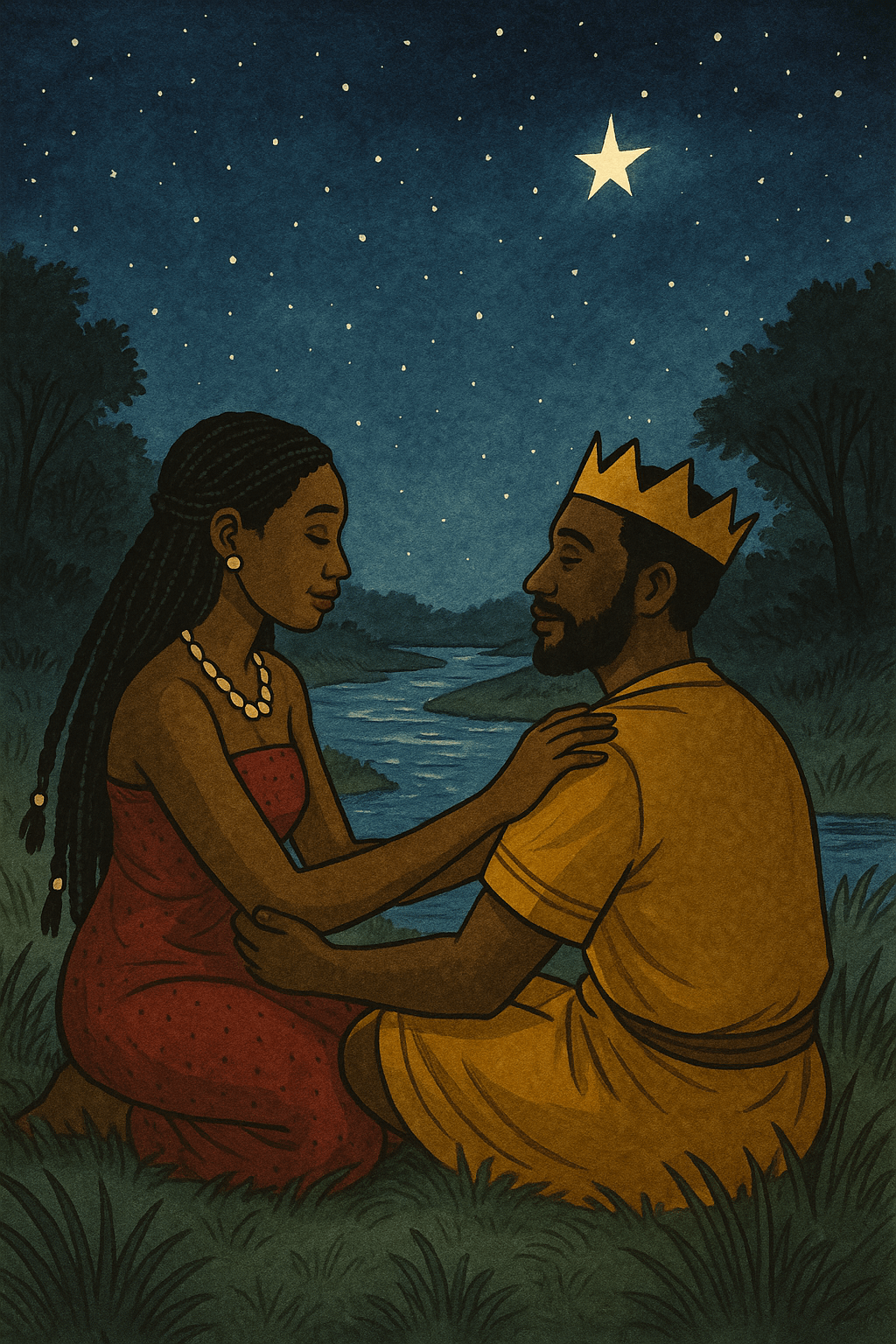
Long before debates about gender equality, polygamy, and the Sustainable Development Goals, the Kingdom of Foumbina had its own grand saga of love and power (the book).
He courted her.
She refused.
He insisted.
And she answered:
“I will love you… if I am yours alone.”
“But I will be king,” he said. “A king takes many wives.”
“Then you will have me… but only for a time.”
This is a dialogue in the tale Nyale, She Who Danced.
This tale is a romance at the sultan’s court in the Foumbina Kingdom (fiction, of course) —set against the reality of polygamy, long the norm in traditional Central African societies.
Between us, Nyale would have been the Marilyn Monroe of that kingdom: fierce, dazzling, and dangerously charismatic.
The prince? Well, he’s the prince — the future king. He has everything handed to him: all the mothers dream of him as the perfect son-in-law, and all the young men dream of being him.
At that time, it was considered an honour to be chosen as one of the king’s wives — and the king had a plethora of possibilities (krkrkr…).
The concept of polygamy and its purpose in the Bamoun kingdom
In the Bamoun kingdom, which inspired this tale, polygamy — or more precisely Polygyny (where one man has several wives) — was not a personal choice. It was a political institution.
Marriage was not simply about love; it was about alliances. Every new wife brought more than beauty — she brought her father’s clan, her brothers’ loyalty, and her lineage’s wealth.
The king, known as the Mfon, often married dozens or even hundreds of women, weaving an invisible net of loyalties across the realm.
This was statecraft in lace wrappers: if every noble’s daughter became the king’s wife, every noble had a stake in the king’s stability. If your daughter lived inside the royal palace, you were far less likely to rebel — and far more likely to send tribute.
This also ensured dynastic security. More wives meant more children, and more children meant more heirs to guard the royal line.
So yes, polygamy was the engine oil of Bamoun politics, and it was less about romance and more about alliances, stability, and continuity.
The place of the woman as wife, mother, and daughter in traditional Bamoun society
Women were central to Bamoun society — often quietly, but powerfully so.
- As wives, they anchored the household. They managed food production, stored harvests, organized household labour, and raised children. A wife’s work was the heartbeat of her family’s survival and honour.
- As mothers, they were revered. Each child brought her more respect, especially sons. In the royal palace, the Queen Mother (Mafo) held extraordinary influence — she advised the king, oversaw the palace women, and could mediate political disputes.
- As daughters, they were the diplomats of their families. A daughter’s marriage could seal peace between rival clans, and the bridewealth she brought home enriched her natal household. She carried her family’s reputation with her, wherever she went.
Though formal political power rested with men, women shaped the foundations of society, weaving the daily fabric of family, economy, and alliance on which the kingdom stood— indirectly, discreetly, yet decisively.
Is polygamy sustainable in this modern economy — and can it help us achieve the Sustainable Development Goals?
In today’s economy, the logic that once supported polygamy has largely disappeared.
Traditional polygamy relied on agricultural wealth, where having many wives meant more hands to farm and more children to secure the family’s labour and lineage. In a modern cash-based economy, however, every child requires significant investment in schooling, healthcare, and housing — and one income rarely stretches far enough to sustain several households.
And the SDGs? Well:
- SDG 1 (No Poverty): When only one person earns and supports a large family, resources are stretched thin and financial shocks (job loss, illness, market changes) can push the entire household into poverty. Building resilience would require multiple independent incomes to share the load and reduce risk.
- SDG 4 (Quality Education): Many children can mean less investment in each child’s education. In large polygamous households, this often forces parents to prioritize some children over others, leaving part of the next generation undereducated and limiting their future opportunities.
- SDG 8 (Decent Work and Economic Growth): When some spouses (women) are confined to domestic roles, the household loses their economic potential. Finances, parenting, and household responsibilities would need to be jointly managed, like a small cooperative. No hidden bank accounts, no secret “favourite” households.
Yes, some point out that modern society has rising rates of infidelity and that humans Homo sapiens sapiens might not be “naturally” monogamous — but neither are we naturally built to sit at desks for 40 hours a week, and yet here we are.
So, could polygamy support the SDGs? Only if completely reimagined: with gender equality, economic independence for each adult, and shared decision-making at its core. Without that transformation, traditional-style polygamy tends to complicate development goals rather than advance them. Otherwise, it’s more likely to achieve SDG 0: Complete Financial Meltdown.
Anyway… I am of the opinion that what people do in their bedroom is what people do in their bedroom. None of my business.
Sources & Further Reading
- Britannica — Bamum: History, Language & Culture
https://www.britannica.com/topic/Bamum Encyclopedia Britannica - Oxford Research Encyclopedia — Women in Cameroon
https://oxfordre.com/africanhistory/display/10.1093/acrefore/9780190277734.001.0001/acrefore-9780190277734-e-574 oxfordre.com - Wikipedia — Ibrahim Njoya
https://en.wikipedia.org/wiki/Ibrahim_Njoya en.wikipedia.org - African History Extra — The invention of writing in an African kingdom (Bamum context)
https://www.africanhistoryextra.com/p/the-invention-of-writing-in-an-african