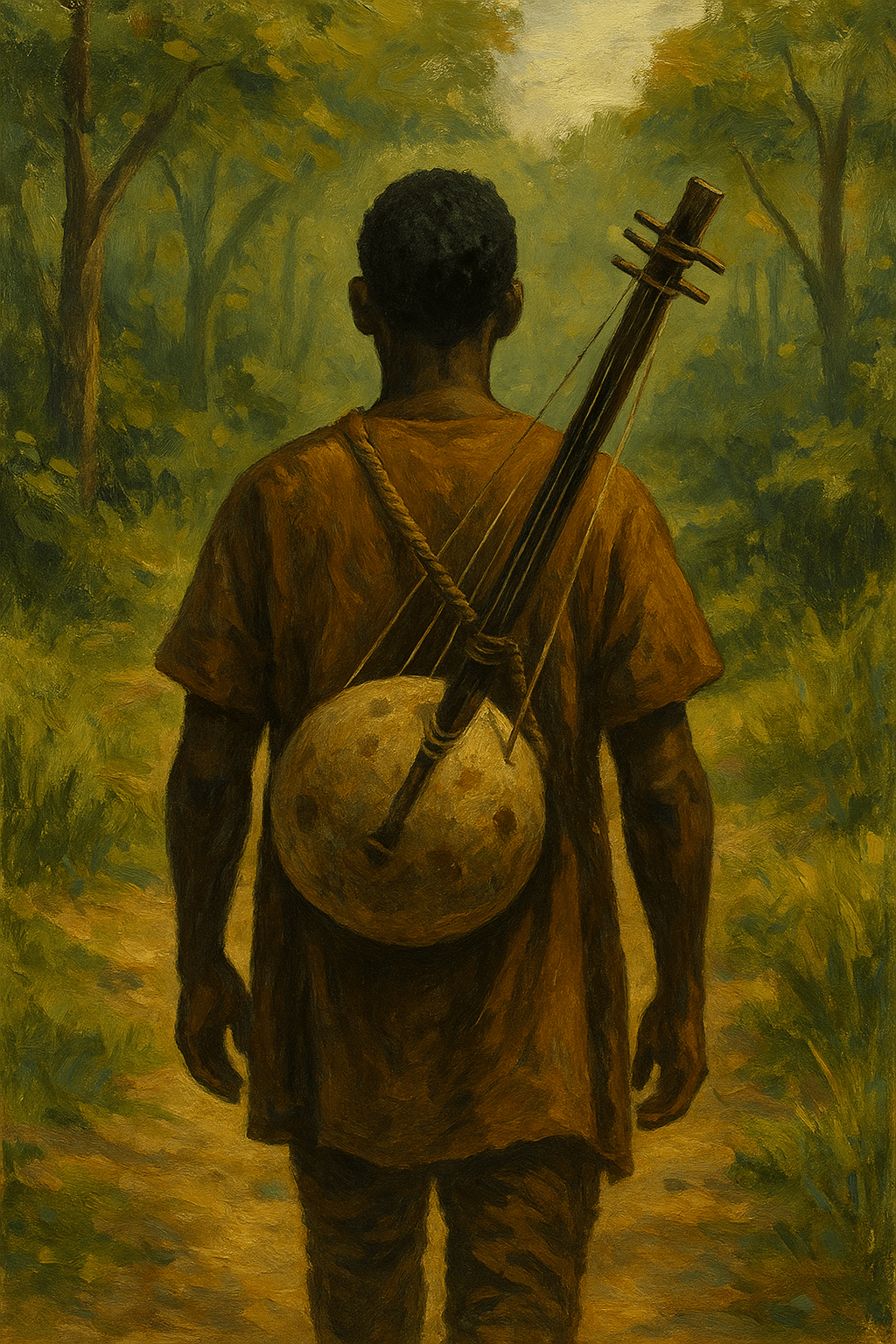
In the story Eyon, the Name Maker (book here), there’s a moment when the main character receives a sacred stringed instrument from the ancestors in a dream.
That scene was inspired by a well known Fang-Beti legend in Cameroon.
Oyono Ada Ngone and the birth of the mvet
In Fang-Beti tradition, there is a legendary figure named Oyono Ada Ngone. He is remembered as the first player of the mvet.
The story says he once fell into a deep, dreamlike trance. In that state, the ancestors, and the supreme being, revealed to him the structure of the mvet and the epic songs that should be sung with it.
When he awoke, Oyono Ada Ngone carved the instrument from raffia wood and began to sing the great stories of his people.
The mvet is not just a musical instrument. It is a bridge:
- between past and present,
- between the living and the ancestors,
- between human beings and the divine.
That story struck me deeply: a dream, an ancestor, a revelation… this sounds familiar.
Ancestors and dreams
Many traditions across Africa tell of ancestors appearing in dreams to give guidance.
Dreams are not private illusions. They are messages.
And death is not a wall. The departed continue to exist, shaping and influencing the lives of the living.
This way of seeing makes the boundary between past and present feel porous, and that made me think about the conception of time in African traditions.
What is time, really?
How often do we say things like:
- “I don’t have time.”
- “Time is running.”
- “The future waits for no one.”
I used to repeat these phrases. But the more I read about African traditions, and the more I talked about this with others, the more I realised:
Time is not only the ticking of a clock or the flipping of a calendar.
Time can also be understood as:
- the measure of change,
- and the way we experience existence.
In the Western modern world, time is usually pictured as a straight line, past → present → future.
Science meets tradition
But physics challenges this “straight arrow” idea.
Einstein showed that time is relative, bending with gravity and speed.
Quantum physics goes further, saying that time may not exist at the deepest level. Instead, it might emerge from relationships. The future, in this view, is not fixed, it is a field of probabilities.
In many African cosmologies like the Fang-Beti or the Dagara, time is event-based and cyclical.
I once had a conversation that made this very concrete.
A friend from Mozambique told me that in his language, Emakhuwa, they have verb tenses that do not exist in Latin or Germanic languages.
For example, in Emakhuwa the past and future are not just one block each. Instead, they are broken into layers:
- immediate past,
- recent past,
- remote past,
- immediate future,
- distant future.
He explained that it can be very hard to translate these into English or French, as these languages don’t have categories for them.
I was baffled… And I realised how much language itself can shape our imagination of time, either as a straight line, or as something richer, layered, and alive.
So when I wrote Eyon, the Name Maker, it wasn’t just about reimagining a legend.
It was also about exploring this deeper idea: that time is not a prison of seconds and minutes, but a dance with memory, presence, and possibility.
Sources & Further Reading
- Manchester Hive – The mvet as myth and history in Beti tradition
https://www.manchesterhive.com/downloadpdf/9781526118714/9781526118714.00017.pdf - Cursus.edu – Understanding the transmission of oral knowledge through the mvet
https://cursus.edu/en/26528/understanding-the-transmission-of-oral-knowledge-through-the-mvet - TV Tropes – Beti-Pahuin Mythology
https://tvtropes.org/pmwiki/pmwiki.php/Myth/BetiPahuinMythology - Balanta.org – The New Afrikan Thought Conference in Yaoundé, Cameroon (mentions Oyono Ada Ngone)
https://www.balanta.org/news/the-new-afrikan-thought-conference-in-yaounde-cameroon-hosted-by-the-international-research-and-documentation-center-on-african-traditions-and-languages-cerdotola - Britannica – John S. Mbiti, African Religions and Philosophy (summary)
https://www.britannica.com/biography/John-S-Mbiti - Princeton University Press – Carlo Rovelli, The Order of Time (2017)
https://press.princeton.edu/books/paperback/9780735216105/the-order-of-time - Ghent University – Devos & Van der Wal (2014), Tense and Aspect in Emakhuwa
https://biblio.ugent.be/publication/4329859