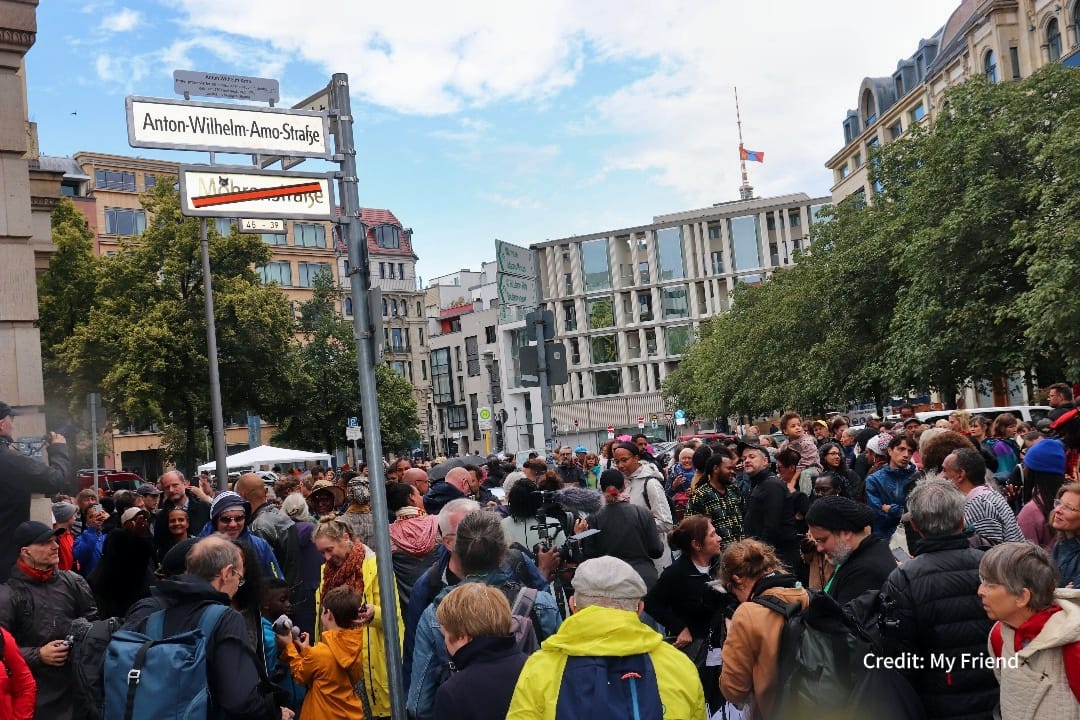
Some weeks ago, I was chatting with a friend. He likes to call me Prof, and I like to call him Dear Colleague.
He started the conversation with:
“Prof, there will be a street renaming in Berlin on August 23rd. Will you be around then?”
I replied:
“I will be, but probably trying to catch up with everything after coming back from Baltimore . But tell me, why are they renaming the street?”
He explained:
“There has been a long-standing protest against Mohrenstraße in Berlin. The protest is about the fact that the name is racist. On the 23rd, the street will be renamed after Anton Wilhelm Amo, an African philosopher who lived in 18th-century Germany. He was brought here as a child enslaved but later became a scholar and argued, under Roman law, why Africans should not be enslaved.”
I asked:
“But why exactly is the name racist? The Moors were present in Europe, and they shared knowledge about plants and medicine with local communities back then.”
He responded:
“The question is: did the Moors call themselves that, or was it a name Europeans gave them? And if Europeans named them, why didn’t they call them by the names the Moors used for themselves?”
I said:
“Ok, I get it. But then we’d have to rename a lot of things. Even the name “Africa” isn’t original, many countries and ethnic groups on the continent still carry names colonizers gave them.”
He replied:
“True. But it has to start somewhere. It’s not just about changing names, it’s about building African agency that can lead to economic and political change. It shows that Black people contributed to Europe’s history and culture.”
A bit of history: who were the Moors?
The Moors were Muslim inhabitants of North Africa — mainly Berbers and Arabs — who crossed into Europe in 711 CE. They ruled large parts of the Iberian Peninsula (modern Spain and Portugal) for several centuries under the name Al-Andalus. During this time, they introduced advanced knowledge in science, medicine, architecture, and agriculture to Europe.
Cities like Córdoba and Granada became centers of learning, famous for libraries, universities, and medical schools. They brought crops such as citrus fruits, sugarcane, and rice, as well as irrigation techniques that transformed European agriculture. Their cultural and scientific influence shaped much of medieval Spain and left a legacy that lasted long after the Reconquista pushed them out in 1492.
… So, basically colonizers coming from Africa.
Then what was wrong with Mohrenstraße?
The word Mohr was originally a neutral term used in Europe for people from North Africa. But over time, especially during colonialism and the slave trade, it started being used by Europeans to label and stereotype Black people rather than call them by their real names or identities.
By the 18th and 19th centuries, the word often appeared in children’s rhymes, tavern signs, and popular culture as a caricature of Blackness, exotic, different, sometimes inferior. Even if it wasn’t meant as an insult centuries ago, today it carries the weight of colonial history. That is why many people in Berlin and beyond find the name problematic and pushed for a change.
About the N-word, the M-word, and “Black”
This brings me to a tricky question: what’s the real difference between the N-word, the M-word (Mohr), and even the word Black?
I like the colour black, it looks elegant, especially on people with cool undertones :). But many African or Afro-descendant people I know are not literally “black.” Their skin tones range from light brown to deep brown, sometimes even golden. So why call everyone “Black”?
Black is a term many Afro-descendant communities chose themselves, as a unifying identity and as a way to reclaim power from “racist” labels. But is it really better than the N-word or the M-word? After all, Black is still not far in meaning from those two words; it also began as an outsider’s description, simply referring to someone with darker skin.
The more I thought about it, the clearer it became that the problem isn’t just the word itself but the intention and the history attached to it. A word can feel empowering or offensive depending on who uses it, why they use it, and what memories it carries.
That’s the magic of WOOORDS …
Disclaimer: I’m not an expert on these matters, and I usually avoid talking about “racial” issues because I see them more as xenophobia, there’s no scientific basis for separate human races [genetic studies show humans are 99.9% identical, with no clear boundaries dividing us into separate biological races].
I’m open to learning, so if you have another perspective, please feel free to comment or send me a DM on Insta.
“The function, the very serious function of racism, is distraction. It keeps you from doing your work. It keeps you explaining, over and over again, your reason for being.” – Toni Morrison
Sources & Further Reading
- Berlin renames controversial ‘Moors’ street after years of debate – NDTV
https://www.ndtv.com/world-news/berlin-renames-controversial-moors-street-after-years-of-debate-9146865 - Mohrenstraße renamed Anton-Wilhelm-Amo-Straße – Wikipedia (German)
https://de.wikipedia.org/wiki/Anton-Wilhelm-Amo-Stra%C3%9Fe - Moors: Overview and Historical Impact – Oxford Islamic Studies
https://bridgingcultures-muslimjourneys.org/items/show/218 - The History and Age of the Moors in Spain: How the Moors Civilized Europe – Ivan Van Sertima.https://www.academia.edu/10524342/The_History_And_the_Age_of_The_Moors_in_Spain_How_The_Moors_Civilized_Europe_by_Ivan_Van_Sertima
- Jena Declaration (2019): The Concept of Race is the Result of Racism, Not its Prerequisite – Wikipedia
https://en.wikipedia.org/wiki/Jena_Declaration - Steven Rose: The Concept of Race is Biologically Meaningless – The Independent
https://www.independent.co.uk/voices/commentators/steven-rose-the-concept-of-race-is-biologically-meaningless-9270507.html - Ashley Montagu – Man’s Most Dangerous Myth: The Fallacy of Race (UNESCO Statement on Race)
https://en.wikipedia.org/wiki/Ashley_Montagu